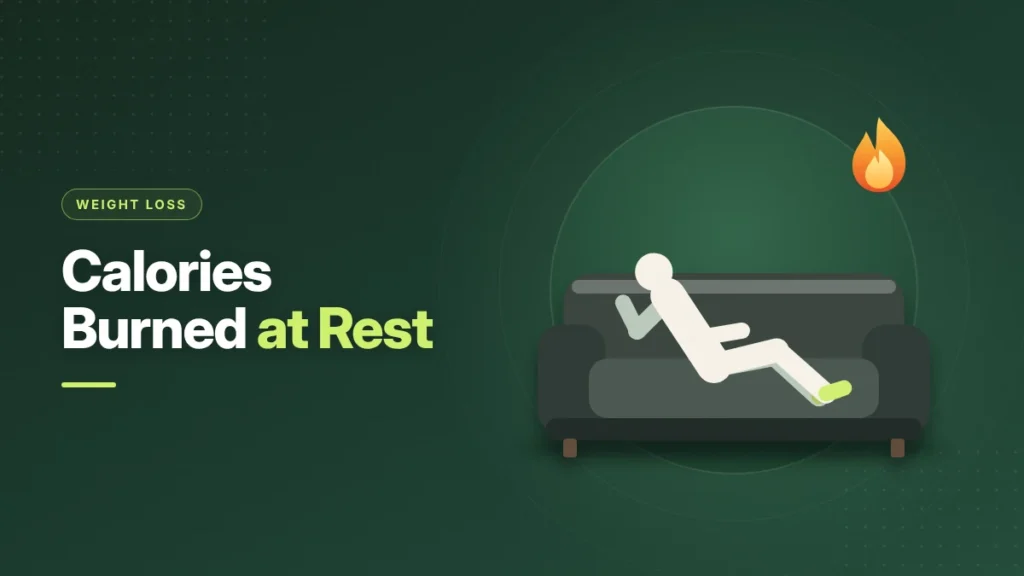
Here’s a fact that surprises a lot of people: most of the calories you burn each day have nothing to do with exercise. Even if you spent the entire day in bed, your body would still burn a significant amount of energy just keeping you alive. So how many calories do you burn doing nothing? For most adults, it’s somewhere between about 1,200 and 1,900 calories a day. That number is called your basal metabolic rate, or BMR.
What Is BMR?
Your BMR is the energy your body needs at complete rest to handle the basics: breathing, pumping blood, keeping your temperature steady, running your brain, and repairing cells.
You’ll also see the term resting metabolic rate (RMR). It’s measured under slightly less strict conditions and usually comes out a little higher, but the two are often used interchangeably.
BMR typically makes up around 60 to 70% of the calories you burn in a day. The rest comes from digesting food (roughly 10%) and all your movement, from workouts to walking around the house.
How to Calculate Your BMR
The most widely used formula is the Mifflin-St Jeor equation, which research has found to be one of the more accurate options for everyday use. You’ll need your weight in kilograms, height in centimeters, and age in years.
- Men: (10 × weight) + (6.25 × height) − (5 × age) + 5
- Women: (10 × weight) + (6.25 × height) − (5 × age) − 161
To convert, divide pounds by 2.2 to get kilograms, and multiply inches by 2.54 to get centimeters.
Two Quick Examples
A 35-year-old woman who is 165 cm tall and weighs 68 kg: (10 × 68) + (6.25 × 165) − (5 × 35) − 161 = about 1,375 calories a day.
A 30-year-old man who is 178 cm tall and weighs 82 kg: (10 × 82) + (6.25 × 178) − (5 × 30) + 5 = about 1,790 calories a day.
Keep in mind that any formula is an estimate. Your real BMR could be 10% higher or lower, depending on factors the equation can’t see.
Where Do Those Calories Actually Go?
You might assume your muscles do most of the burning, but your organs are the real heavy hitters. Your brain, liver, heart, and kidneys make up only a small share of your body weight, yet together they account for a large portion of your resting energy use.
Muscle still matters. At rest, a pound of muscle burns roughly 6 calories a day, compared with about 2 calories for a pound of fat. That’s a real difference, but smaller than many fitness myths claim. Adding 5 pounds of muscle might raise your BMR by around 30 calories a day, not hundreds.
For perspective, Harvard Health Publishing estimates that a 155-pound person burns about 22 calories in 30 minutes of sleep and about 40 calories reading while seated.
What Affects Your BMR?
- Body size: larger bodies need more energy to maintain.
- Muscle mass: more lean tissue means a modestly higher BMR.
- Sex: men tend to have higher BMRs, largely because they usually carry more muscle and are bigger on average.
- Age: recent research suggests metabolism stays fairly stable from about age 20 to 60, then slowly declines. Much of the “slowing down” people notice earlier often comes from moving less and losing muscle.
- Genetics and hormones: thyroid hormones in particular have a big effect.
- Dieting: long periods of eating far below your needs can cause your body to burn slightly less energy as it adapts.
How BMR Fits Into Your Daily Calorie Needs
Your BMR is only the starting point. To estimate how many calories you burn in a full day, multiply it by an activity factor: about 1.2 if you’re mostly sedentary, 1.375 if lightly active, 1.55 if moderately active, and 1.725 if very active.
That gives you your total daily energy expenditure, or maintenance calories. Our step-by-step guide on how to figure out maintenance calories goes into more detail, and if you’re aiming for weight loss or muscle gain, see how many calories you should have.
Can You Raise Your BMR?
A little, yes. The most reliable way is strength training to build and keep muscle. Our guide on how to gain muscle is a good starting point. Eating enough protein and staying active throughout the day also helps your total burn. For more ideas, read our guide on how to get a fast metabolism.
The Bottom Line
You burn a surprising number of calories doing nothing, usually 1,200 to 1,900 a day for adults, thanks to your BMR. Use the Mifflin-St Jeor equation for a solid estimate, then factor in your activity level to find your daily needs. Building muscle and moving more can nudge your burn upward, but small daily habits will always matter more than any metabolic shortcut.
Written by Kashan | FitnessMethodology.com — Your trusted destination for practical fitness tips, smarter nutrition, and healthier living. We empower you to make smarter choices, build healthier habits, and achieving your fitness goals .
Health note: This article is general information, not medical advice. Check with a doctor or registered dietitian before making big changes to your diet or training, especially if you have a health condition, are pregnant or take medication. Read our full disclaimer.