Ask ten people how many calories you should eat and you’ll get ten different answers. A better question: how many calories keep your weight right where it is? Once you know how to figure out maintenance calories, losing fat or building muscle gets much easier to plan.
All you need is a quick formula, an honest look at your activity and a few weeks of watching the scale. Here’s the step-by-step method.
What Are Maintenance Calories?
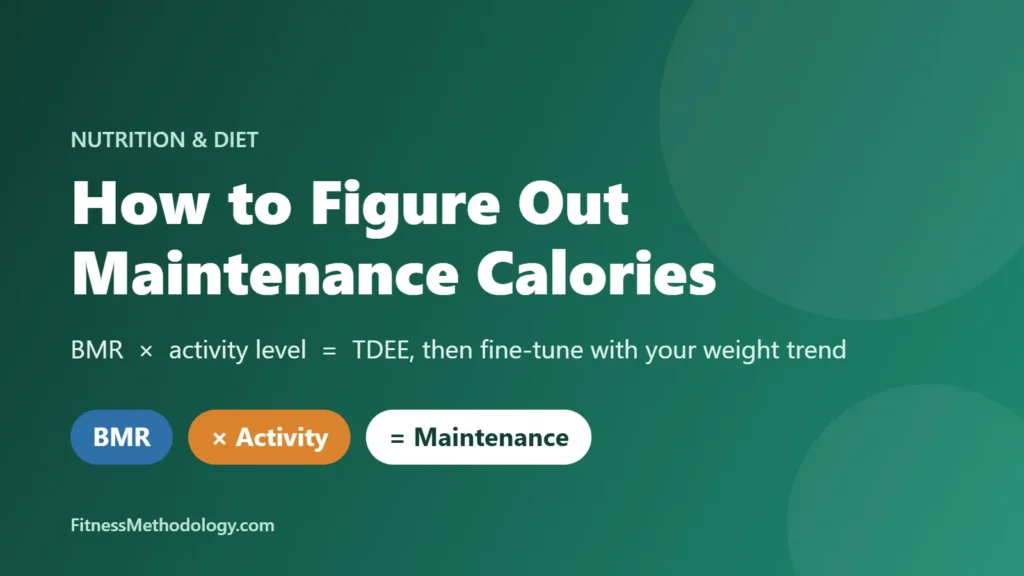
Maintenance calories are what you need each day to keep your weight stable. In practice, that’s your total daily energy expenditure (TDEE), which is made up of:
- Basal metabolic rate (BMR): the energy you burn at rest, usually the biggest chunk.
- Activity: workouts plus everyday movement.
- Digestion: a small amount used to process food.
How to Figure Out Maintenance Calories in 3 Steps
Step 1: Estimate Your BMR
The Mifflin-St Jeor equation is a solid starting point. A systematic review found it predicted resting metabolic rate within 10% of measured values more often than other common equations, though it can still miss for individuals.
- Men: (10 × weight in kg) + (6.25 × height in cm) − (5 × age) + 5
- Women: (10 × weight in kg) + (6.25 × height in cm) − (5 × age) − 161
Using pounds and inches? Divide pounds by 2.2 and multiply inches by 2.54.
Step 2: Multiply by Your Activity Level
| Activity level | Multiply BMR by |
|---|---|
| Sedentary (desk job, little exercise) | 1.2 |
| Lightly active (exercise 1–3 days a week) | 1.375 |
| Moderately active (exercise 3–5 days a week) | 1.55 |
| Very active (hard exercise 6–7 days a week) | 1.725 |
Three gym sessions don’t cancel out eight hours of sitting a day. If you’re stuck between two levels, pick the lower one. Prefer not to do the math? Try our free calorie calculator.
Step 3: Check It Against Your Weight Trend
Your result is an estimate. Eat close to that number for two to four weeks and weigh yourself several mornings a week. Compare weekly averages, not single days, since water and salt can swing the scale overnight.
If your average holds steady, you’ve found maintenance. If it keeps drifting, adjust by 100 to 200 calories. Roughly, a steady change of half a pound per week suggests you’re about 250 calories a day off.
A Simple Calculation Example
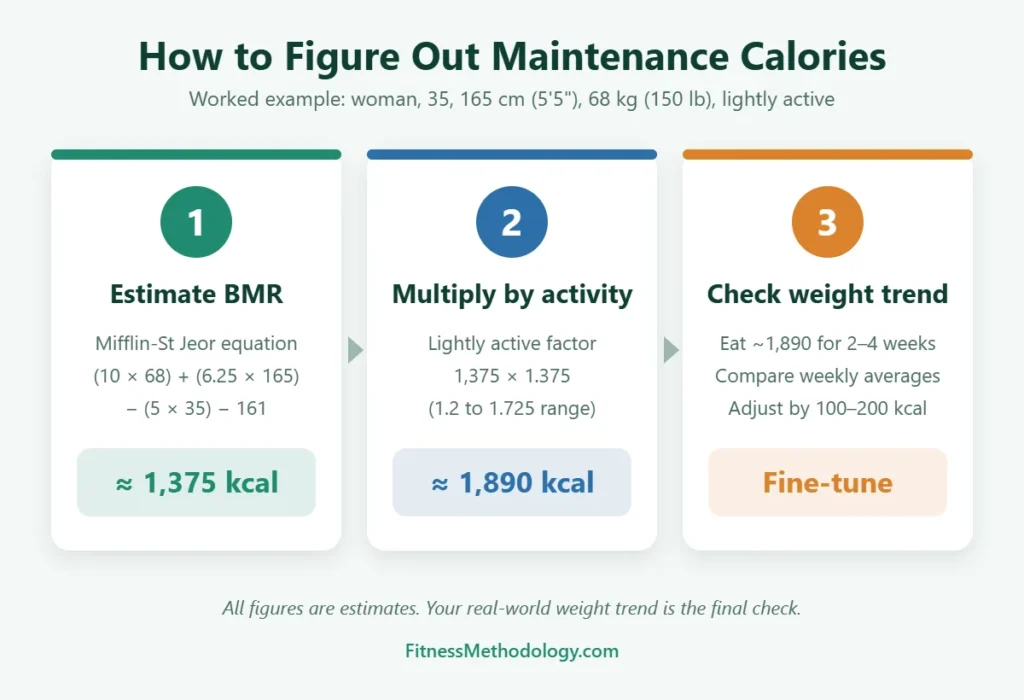
Meet Sarah: 35, 5’5″ (165 cm), 150 pounds (68 kg), desk job, light exercise twice a week.
- BMR: (10 × 68) + (6.25 × 165) − (5 × 35) − 161 ≈ 1,375 calories
- TDEE: lightly active, so 1,375 × 1.375 ≈ 1,890 calories
Her estimated maintenance is about 1,890 calories. If, after three weeks, her average is dropping half a pound a week, her true maintenance is probably closer to 2,140, so she eats a little more.
Maintenance Calories Calculator
Want to skip the math? Enter your details below and the calculator runs the same Mifflin-St Jeor formula and activity multipliers from the steps above. To check it, plug in Sarah’s numbers: you should get about 1,890 calories a day.
Free tool
Maintenance Calories Calculator
Your estimated maintenance calories0calories per day
BMR (calories burned at rest): 0
Numbers are rounded to the nearest 10. Treat them as a starting point: eat close to your maintenance number for 2 to 4 weeks, compare weekly average weigh-ins, and adjust by 100 to 200 calories if your weight keeps drifting.
Estimates use the Mifflin-St Jeor equation and standard activity multipliers. Results can differ from your real needs. This calculator is for healthy adults; if you’re under 18, pregnant or breastfeeding, or managing a medical condition, check with a doctor or registered dietitian.
Treat your results as a starting point, not a fixed rule. The maintenance number is the baseline you test over the next few weeks. The weight-loss figure sits about 500 calories below it, and the gain figure adds a modest 250 to help limit fat gain. If a target looks very low, Harvard Health advises not going below 1,200 calories a day for women or 1,500 for men unless a health professional is supervising.
Maintenance vs. Calories for Weight Loss or Gain
Maintenance is your baseline. To lose weight, eat below it; many people start around 500 calories under. The CDC notes that people who lose about 1 to 2 pounds a week are more likely to keep it off. To gain weight or build muscle, eat modestly above it while strength training. For general ranges by age and goal, see how many calories you should have.
NIH researchers have shown the old “3,500 calories per pound” rule overestimates weight change over time, partly because you burn less as you get lighter. The NIH Body Weight Planner accounts for this.
Why Maintenance Calories Vary Between People
Two people with identical stats can have different maintenance numbers. Muscle burns more energy than fat, and someone who paces during calls and takes the stairs can burn noticeably more than a same-sized coworker. Genetics, sleep, medical conditions and medications matter too.
Practical Tips for Accurate Tracking
- Weigh calorie-dense foods like oils, nuts and cheese for a few weeks.
- Log everything, including drinks, sauces and weekend meals.
- Build your calories around a balanced diet with plenty of high-fiber foods so your number is easier to stick to.
FAQs
Is TDEE the same as maintenance calories?
Essentially, yes. TDEE is what you burn in a day, and eating that amount keeps your weight stable.
How long does it take to find my maintenance calories?
Usually two to four weeks of steady eating and weigh-ins. Shorter tests get thrown off by water swings.
Do maintenance calories change over time?
Yes. They shift as your weight, age, muscle mass and activity change, so recheck every few months.
The Bottom Line
To figure out maintenance calories, estimate your BMR, multiply it by an honest activity factor, then test that number against your weight trend for a few weeks. The formula gets you close; the scale fills in the rest. If you have a medical condition, ask a registered dietitian.
Written by Kashan | FitnessMethodology.com — Your trusted destination for practical fitness tips, smarter nutrition, and healthier living. We empower you to make smarter choices, build healthier habits, and achieving your fitness goals .
Health note: This article is general information, not medical advice. Check with a doctor or registered dietitian before making big changes to your diet or training, especially if you have a health condition, are pregnant or take medication. Read our full disclaimer.