

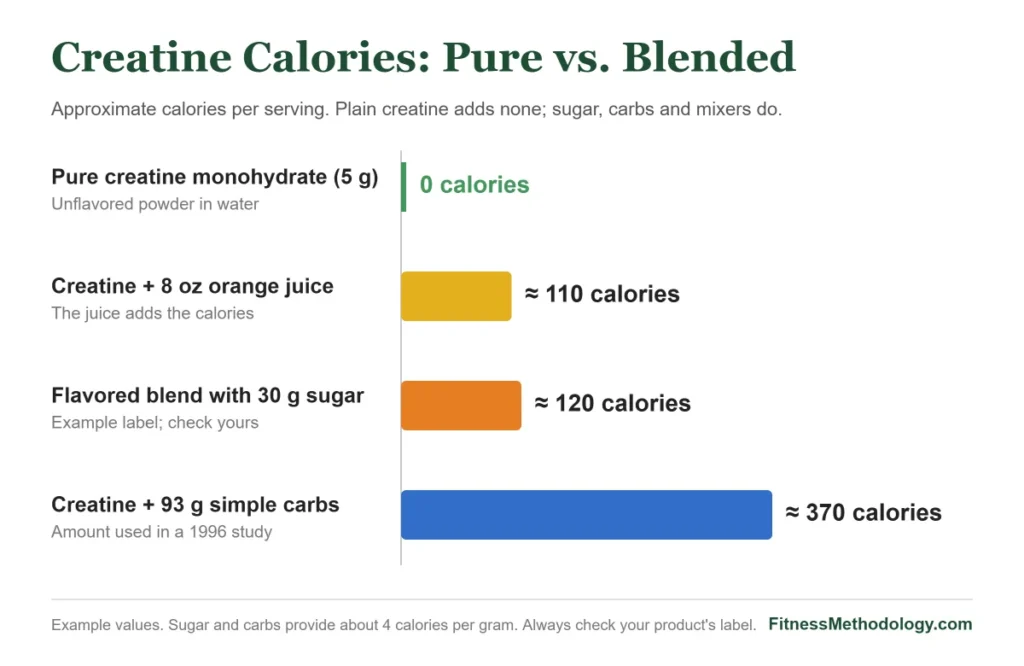
Does creatine have calories? Here’s the short answer: pure creatine monohydrate has no meaningful calories. A standard 3–5 gram scoop is listed as 0 calories on most labels, so it won’t throw off your food log or your cut.
The catch? Not every tub labeled “creatine” is just creatine. Flavored powders, gummies, and blends can add sugar and carbs. Here’s what to know.
Does Creatine Have Calories? The Science
Your body makes creatine from amino acids, mostly in the kidneys and liver, and you get small amounts from meat and fish. But creatine isn’t a protein, carb, or fat. Its job is to help muscles recycle energy quickly, not to supply calories.
That’s why the nutrition panel on pure creatine monohydrate typically shows 0 calories, 0 g carbs, 0 g fat, and 0 g protein per serving. One honest nuance: US labeling rules allow anything under 5 calories per serving to be rounded down to zero. So “0” really means “too small to matter.”
Does Creatine Affect Calorie Tracking?
For pure creatine, no. If you’re working toward a daily calorie target, log it as zero or skip it.
What you mix it with is a different story. An 8-ounce glass of orange juice adds about 110 calories. The creatine stays at zero; the drink doesn’t.
When Creatine Products Do Contain Calories
Some products blend creatine with sugar. The idea comes from older research: a 1996 study found that taking creatine with a large dose of simple carbs (about 93 grams) increased how much creatine the body retained. But 93 grams of sugar is roughly 370 calories per serving.
You’ll often find added calories in:
- Flavored creatine powders sweetened with sugar or maltodextrin
- Creatine gummies, which often contain sugar or syrups
- Pre-workout and post-workout blends with carbs or protein
- Mass gainers that list creatine as one ingredient among many
How to Check the Label
Skip the front of the tub and read the Supplement Facts or Nutrition Facts panel. Check calories, carbohydrates, added sugars, and serving size. A blend with 30 grams of sugar per serving adds about 120 calories; plain creatine adds none.
What Creatine Actually Does for Performance
Most of your creatine is stored in muscle, where it helps regenerate ATP, the fuel for short, intense efforts. According to the International Society of Sports Nutrition, supplementing raises muscle creatine stores, which may explain improvements in high-intensity exercise and training adaptations. That can support your efforts to gain muscle.
Keep expectations realistic. The NIH Office of Dietary Supplements notes creatine seems most helpful for repeated bursts like lifting and sprinting, with less clear benefit for endurance events. It won’t replace consistent training, protein, and sleep, and results take time (here’s a realistic muscle-building timeline).
Most research supports 3–5 grams per day. A loading phase of about 20 grams daily for 5–7 days fills muscles faster, but it isn’t required.
Creatine Powder vs. Flavored Supplements
Plain creatine monohydrate is the most researched form, usually the cheapest per serving, and nearly tasteless.
Flavored versions trade simplicity for taste, and sometimes calories. If tracking matters, plain powder is easier. If a flavored product helps you stay consistent, that’s fine too. Just log what the label says.
Common Creatine Misconceptions
“Creatine makes you fat.” Pure creatine has no meaningful calories, so it can’t directly cause fat gain. A 2021 review by creatine researchers found it doesn’t increase fat mass.
“The early weight gain is fat.” A small bump in the first week is mostly extra water stored in muscle, especially during loading.
“Creatine is a steroid.” It isn’t. It’s a compound found naturally in your body and in foods like meat and fish.
“Creatine damages your kidneys.” Research in healthy people hasn’t shown harm at recommended doses. If you have kidney disease or take regular medication, talk with your doctor first.
FAQs
Does creatine break a fast?
Pure creatine has no meaningful calories, so most people consider it fasting-friendly. Sweetened or flavored versions may not be.
Does creatine count toward my protein intake?
No. Creatine isn’t a protein source, so don’t count it toward your protein target.
How many calories are in creatine gummies?
It depends on the brand. Many gummies contain sugar, so check the label for calories per serving rather than assuming zero.
Will creatine make me gain weight?
You might notice a small early bump from water. Beyond that, any gain usually reflects muscle built through training, not fat.
The Bottom Line
So, does creatine have calories? Pure creatine monohydrate is effectively calorie-free and won’t affect your tracking. Any calories come from added sugar, carbs, or whatever you mix it with. Choose plain powder for simplicity, read labels on flavored products, and pair creatine with smart training.
Written by Kashan | FitnessMethodology.com — Your trusted destination for practical fitness tips, smarter nutrition, and healthier living. We empower you to make smarter choices, build healthier habits, and achieving your fitness goals .
Health note: This article is general information, not medical advice. Check with a doctor or registered dietitian before making big changes to your diet or training, especially if you have a health condition, are pregnant or take medication. Read our full disclaimer.