
Competitive swimmers tend to have broad shoulders, strong backs and lean, athletic builds. So it is a fair question to ask: does swimming build muscle, or is it just a good cardio workout?
The short answer is yes, swimming can build muscle, especially if you are new to exercise or coming back after a break. Water pushes back against every stroke and kick, so your muscles are working against resistance the entire time you move. But swimming has limits. On its own, it usually will not add size the way a progressive weight-training program can, and how much muscle you gain depends on how you train in the pool, what you eat and what you do outside the water.
This guide explains how swimming builds muscle, which muscles each stroke works, what the research actually shows, and practical ways to get more strength and muscle out of your time in the pool.
Does Swimming Build Muscle? The Short Answer
Yes, but the gains are modest. A 2018 systematic review and meta-analysis in Sports Medicine pooled swim-training studies in non-elite swimmers and found that swimming increased lean body mass by about 2 kg on average compared with control groups. The same review found reductions in body fat percentage and improvements in aerobic fitness (Lahart & Metsios, 2018).
That is a meaningful result for an activity most people think of as cardio. Keep two things in mind, though. First, lean mass includes more than muscle (it also counts water, organs and bone), so it is not a direct measure of muscle size. Second, most of the people in these studies were not already highly trained. Once your body adapts to a swimming routine, muscle growth tends to slow down unless you keep making the work harder.
How Swimming Builds Muscle
Water provides constant resistance
Water is far denser than air, so every pull, push and kick has to move against it. The harder and faster you move, the more drag you create, which means you can raise the challenge simply by swimming with more effort. Unlike a dumbbell, which mainly resists you in one direction, water resists you throughout the whole movement.
It works many muscles at the same time
Swimming is a full-body exercise. Your arms, shoulders and back drive you forward, your legs kick, and your core holds your body in a streamlined position and helps you rotate. Few cardio activities train this many muscle groups at once.
It mainly trains muscular endurance
Lap after lap, your muscles contract over and over at a low-to-moderate load. That is excellent for muscular endurance, which is your ability to keep working without tiring. It is a weaker signal for maximum strength or muscle size. Short, hard efforts such as sprints and intervals push your muscles closer to their limit, and that is where more of the muscle-building stimulus comes from.
Which Muscles Does Swimming Work?
According to Sport Singapore’s ActiveSG guide to swimming muscle groups, every stroke uses your core and lower back, shoulders, upper back, forearms, glutes and hamstrings. Each stroke then puts extra emphasis on different areas:
| Stroke | Muscles emphasized | Good to know |
|---|---|---|
| Freestyle (front crawl) | Shoulders, lats and upper back, abdominals and obliques (for rotation), hip flexors and legs | The most common lap stroke and easy to sustain for longer sets |
| Backstroke | Shoulders, lats and upper back, core and obliques, hip flexors and legs | Uses many of the same muscles as freestyle, swum on your back |
| Breaststroke | Chest and lats (inward arm sweep), glutes and quadriceps (kick) | The kick puts more of the work on your hips and legs |
| Butterfly | Chest, lats, shoulders, biceps and triceps, core and lower back, glutes, quads, hamstrings and calves | The most demanding stroke; best used in short bursts |
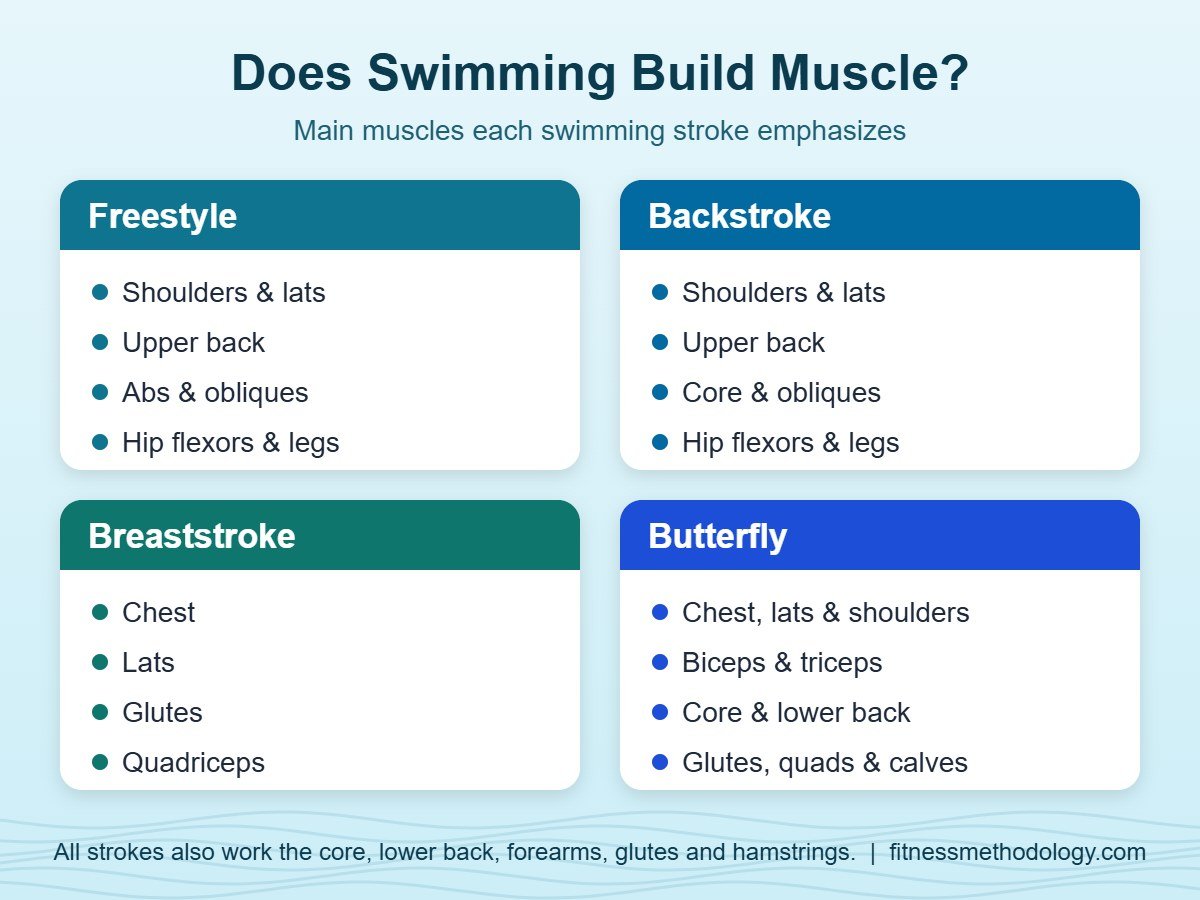
Exactly how hard each muscle works will vary with your technique, speed and body position, so think of this as a general guide rather than a fixed rule.
Benefits of Swimming for Muscle and Overall Fitness
- Adds some lean mass. As noted above, swim training increased lean mass by roughly 2 kg compared with non-exercising controls in the 2018 meta-analysis.
- Builds muscular endurance. Repeated strokes train your shoulders, back, core and legs to work for longer before fatiguing.
- Improves cardiovascular fitness. The same review found that swimming raised VO2max (a key measure of aerobic fitness) by about 6.3 mL/kg/min compared with controls.
- Helps body composition. Body fat percentage dropped by about 1.9 percentage points compared with controls, which can make muscle more visible.
- Easy on the joints. Because water supports much of your body weight, swimming involves far less impact than running or jumping, which makes it a useful option if impact exercise bothers your knees, hips or back.
- Counts toward your weekly activity target. The CDC recommends that adults get at least 150 minutes of moderate-intensity aerobic activity each week, and swimming laps is an efficient way to do it.
Limitations: Why Swimming Alone May Not Build Much Muscle
Progressive overload is harder to apply
Muscles grow when you gradually ask them to do more than they are used to. In the gym, that is as simple as adding weight or reps. In the pool, you can swim faster, cut your rest, or use equipment, but the load on any single muscle stays relatively light compared with heavy lifting. That is why progress often stalls after the first few months of regular swimming.
It is mostly an endurance stimulus
A 2024 randomized controlled trial in Scientific Reports followed 80 sedentary adults aged 60 to 70 for 16 weeks. The group that did high-intensity freestyle intervals improved most on a walking endurance test. The clearest improvements in strength tests, such as the chair stand and arm curl, appeared in the groups that did aquatic resistance exercises like water squats, jumps and chest presses (Chen et al., 2024). The effects were small and the study involved older adults, but it supports the idea that adding resistance work is what drives strength gains.
It does not load your bones much
Bones respond to impact and heavy loading, and swimming offers little of either. A systematic review in PLoS One found that swimmers tend to have bone mineral density similar to sedentary people and lower than athletes in high-impact sports. Swimming did not appear to harm bone, but it is not one of the best activities for building it (Gómez-Bruton et al., 2013).
It may not cover your strength-training needs
The CDC also recommends muscle-strengthening activities on at least 2 days a week that work all major muscle groups: legs, hips, back, abdomen, chest, shoulders and arms. For most people, adding a couple of short strength sessions alongside swimming is the simplest way to meet that recommendation.
Swimming vs. Weight Lifting for Muscle Growth
Swimming and weight training are not rivals. They do different jobs, and they work well together.
| Swimming | Weight training | |
|---|---|---|
| Main benefit | Cardio fitness and muscular endurance | Strength and muscle size |
| Muscle growth potential | Modest, highest for beginners | High, with progressive overload |
| How you progress | Speed, intervals, equipment, shorter rest | More weight, reps or sets |
| Joint impact | Very low | Low to moderate, depending on the exercise |
| Bone loading | Low | Higher |
| Cardio benefit | High | Lower, unless done as circuits |
If your main goal is visibly bigger muscles, weight training should be the foundation, with swimming as conditioning and active recovery. If your main goal is overall fitness with a lean, athletic look, swimming can be your main workout, backed up by two strength sessions a week.
How to Build More Muscle With Swimming: 8 Practical Tips
1. Swim harder, not just longer
Easy, steady laps are great for endurance, but they do little for muscle size. Add short, hard efforts to your workouts. For example, after a warm-up, try 8 × 25 m (one pool length) at close to full effort, with 30 to 60 seconds of rest between each. As you get fitter, add more repeats or shorten the rest.
2. Add resistance equipment
Hand paddles make your upper body move more water with every pull. Fins let you kick harder and faster. A pull buoy isolates your arms and back, and a kickboard isolates your legs. Drag shorts or a swim parachute add extra resistance to the whole body. Introduce paddles gradually, since they also put more stress on your shoulders.
3. Mix your strokes
Each stroke emphasizes slightly different muscles, so rotating through freestyle, backstroke, breaststroke and, if you can, short sets of butterfly gives your whole body a more balanced workout.
4. Try aquatic resistance exercises
You do not have to swim laps to train in water. Squats, lunges, jumps, chest presses and arm raises in waist- or chest-deep water, especially with foam water dumbbells, add resistance work without impact. This is the type of training that produced the strength improvements in the 2024 trial mentioned above.
5. Add two days of strength training
Simple bodyweight or gym exercises fill the gaps swimming leaves. Good choices include squats, lunges or step-ups for your legs, push-ups for your chest, rows or pull-ups for your back, and planks for your core. If you are new to lifting, our guide on how long it takes to build muscle explains what results to expect and when.
6. Eat enough protein and calories
Muscle needs building material. A large meta-analysis in the British Journal of Sports Medicine found that, for people doing resistance training, total protein intake above about 1.6 g per kilogram of body weight per day gave no further gains in fat-free mass (Morton et al., 2018). For a 70 kg person, that works out to roughly 112 g of protein a day, spread across meals.
Swimming can burn a lot of energy, so make sure you are not eating too little if your goal is to gain muscle. Our guide to a balanced diet and calorie guide can help you plan meals that support your training.
7. Prioritize recovery and sleep
Muscle is built while you recover, not during the workout itself. Space out your hardest sessions, take at least one rest day a week, and aim for consistent, good-quality sleep.
8. Progress gradually and look after your shoulders
A single swim session can involve hundreds of shoulder rotations. Build your distance and intensity step by step, focus on good technique, and stop if you feel sharp or persistent pain. A swim coach or physiotherapist can help you fix technique problems early.
Sample Weekly Plan: Swimming Plus Strength
Here is one example of how to combine swimming and strength training across a week. Adjust it to your fitness level and schedule.
| Day | Workout |
|---|---|
| Monday | Swim: warm-up, sprint intervals (e.g., 8 × 25 m hard), easy cool-down |
| Tuesday | Strength: squats, lunges, push-ups, rows, planks |
| Wednesday | Easy technique swim or rest |
| Thursday | Swim with equipment: paddle and pull-buoy sets, kickboard sets |
| Friday | Strength: step-ups or deadlifts, pull-ups or lat pulldowns, overhead press, core work |
| Saturday | Mixed-stroke swim or aquatic resistance session |
| Sunday | Rest |
With three to four swims of about 40 to 50 minutes and two strength sessions, this plan meets the CDC’s recommendations for both aerobic and muscle-strengthening activity. If you are a beginner, start with two swims and two short strength sessions and build from there.
Who Benefits Most From Swimming for Muscle?
- Beginners and people returning to exercise. If your muscles are not used to regular training, swimming can produce noticeable strength and endurance gains.
- People who find high-impact exercise uncomfortable. Water support makes it easier to train consistently when running or jumping is not an option.
- Older adults. Swimming and water-based resistance exercise can help maintain fitness and strength with less joint stress.
- Lifters and runners looking for cross-training. Swimming builds aerobic fitness without adding much impact on top of your main training.
If you have a heart condition, joint problems, or any other health concern, check with your doctor before starting a new exercise program.
Frequently Asked Questions
Can you build muscle by swimming only?
Yes, especially at the beginning. Research shows that swim training can increase lean mass compared with not exercising. However, growth usually slows once your body adapts, so most people who want more muscle size eventually need to add resistance training.
How long does it take to see muscle from swimming?
It depends on your starting point, how often you swim, how hard you train and how well you eat. Many people notice better endurance and strength within a few weeks, while visible changes usually take a few months of consistent training. Our article on building muscle timelines goes into more detail.
Which swimming stroke builds the most muscle?
Butterfly is the most physically demanding stroke and works a large amount of muscle, but it is hard to sustain. Freestyle is the most practical for longer workouts. For the best overall results, mix your strokes and include hard intervals.
Is swimming better than the gym for building muscle?
Not for muscle size. Weight training lets you add load in small, measurable steps, which is the most reliable way to build muscle and strength. Swimming is better for cardiovascular fitness and is easier on the joints. Combining the two gives you the benefits of both.
Does swimming tone your body?
“Toning” usually means building some muscle while losing body fat, and swimming can help with both. The 2018 meta-analysis found that swim training increased lean mass and lowered body fat percentage compared with controls.
How many times a week should I swim to build muscle?
There is no single magic number. A practical approach for most people is two to four swim sessions a week that include some hard efforts, plus two strength-training sessions. That keeps you in line with the CDC’s activity recommendations and gives your muscles time to recover.
Will swimming make me bulky?
It is unlikely. Swimming mainly builds endurance and a lean, athletic look. Gaining a lot of muscle size generally requires heavy, progressive resistance training and a calorie surplus.
The Bottom Line
So, does swimming build muscle? Yes, it does, though modestly. Water resistance works your shoulders, back, chest, arms, core and legs, and research shows swim training can add lean mass while improving cardiovascular fitness and reducing body fat. Its main limits are that it is mostly an endurance stimulus, it is hard to progressively overload and it does little for bone loading.
To get the most from the pool, swim with more intensity, use equipment, mix your strokes, eat enough protein, and add two days of strength training each week. That combination gives you the strength and muscle of resistance training with the heart health and low impact of swimming. For more on pairing training with good habits, see our guide to a balanced diet and regular exercise.
This article is for general information only and is not medical advice. Please read our disclaimer and speak to a qualified health professional before starting a new exercise program.
Keep Reading
- Does Swimming Get You Fit? What the Pool Really Does for Your Body
- How Long Does It Take to Build Muscle? A Realistic Timeline
- Balanced Diet and Regular Exercise: A Simple Guide to Better Health
- What Is a Balanced Diet? Foods, Benefits, and Examples
- Building a Sustainable Approach to Health and Fitness
References
- Lahart IM, Metsios GS. Chronic physiological effects of swim training interventions in non-elite swimmers: a systematic review and meta-analysis. Sports Medicine. 2018;48:337–359. Read the study
- Chen Y, et al. High-intensity interval swimming improves cardiovascular endurance, while aquatic resistance training enhances muscular strength in older adults. Scientific Reports. 2024;14:25241. Read the study
- Gómez-Bruton A, et al. Is bone tissue really affected by swimming? A systematic review. PLoS One. 2013;8(8):e70119. Read the study
- Morton RW, et al. A systematic review, meta-analysis and meta-regression of the effect of protein supplementation on resistance training-induced gains in muscle mass and strength in healthy adults. British Journal of Sports Medicine. 2018;52(6):376–384. Read the study
- Centers for Disease Control and Prevention. Adult Activity: An Overview.
- ActiveSG Circle (Sport Singapore). What Muscle Groups Does Swimming Develop?
Health note: This article is general information, not medical advice. Check with a doctor or registered dietitian before making big changes to your diet or training, especially if you have a health condition, are pregnant or take medication. Read our full disclaimer.