Here’s the quick answer on how to measure BMI: measure your height, weigh yourself, then divide your weight in kilograms by your height in meters squared. Using pounds and inches? Do the same division and multiply by 703.
The math is easy. Accurate measurements and knowing BMI’s limits matter more.
What Is BMI?
Body mass index (BMI) compares your weight to your height. The CDC calls it a quick, low-cost screening measure for underweight, overweight, and obesity. It can flag that something deserves a closer look, but it doesn’t diagnose anything or measure body fat directly.
How to Measure BMI Step by Step
Step 1: Measure Your Height
Stand barefoot against a wall, heels together, looking straight ahead. Rest a flat object, like a hardcover book, on your head so it touches the wall. Mark the spot and measure from the floor to the mark.
Step 2: Weigh Yourself
Use a digital scale on a hard, flat floor. Morning works best, after the bathroom and before breakfast, in light clothing. Weighing the same way each time keeps results comparable.
Step 3: Use the BMI Formula
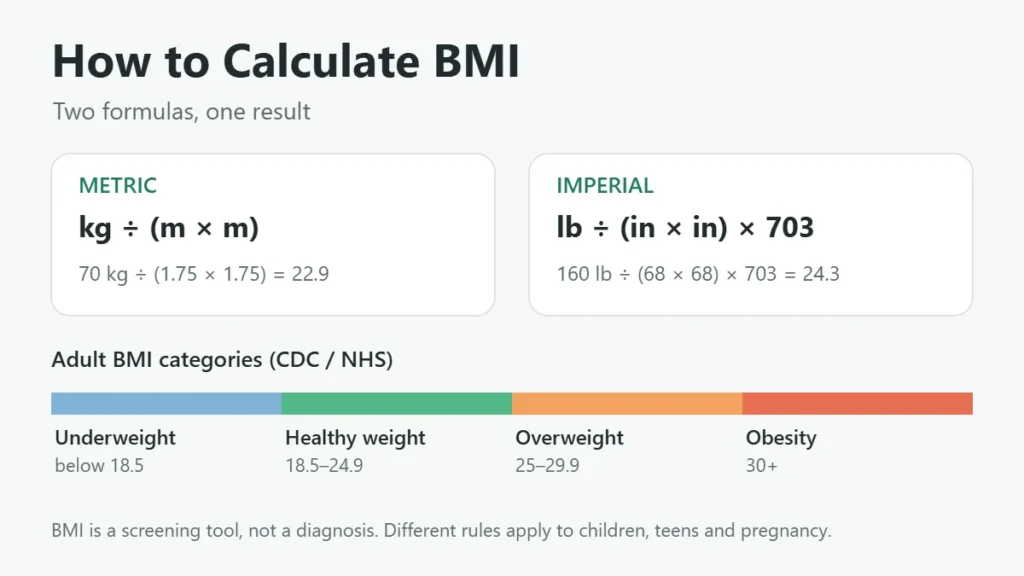
- Metric: BMI = weight (kg) ÷ height (m)²
- Imperial: BMI = weight (lb) ÷ height (in)² × 703
The 703 is just a conversion factor, so both versions give the same answer.
BMI Calculation Examples
In Kilograms and Meters
Say you weigh 70 kg and you’re 1.75 m tall.
- Square your height: 1.75 × 1.75 = 3.0625
- Divide your weight by it: 70 ÷ 3.0625 = 22.9
Measured in centimeters? Divide by 100 first, so 175 cm becomes 1.75 m.
In Pounds and Inches
Now say you weigh 160 lb and stand 5 feet 8 inches tall.
- Convert height to inches: (5 × 12) + 8 = 68 inches
- Square it: 68 × 68 = 4,624
- Divide your weight by it: 160 ÷ 4,624 = 0.0346
- Multiply by 703: 0.0346 × 703 = 24.3
Adult BMI Categories
The CDC uses these ranges for adults 20 and older, and the NHS uses the same cutoffs from age 18.
| BMI | Category |
|---|---|
| Below 18.5 | Underweight |
| 18.5 to 24.9 | Healthy weight |
| 25.0 to 29.9 | Overweight |
| 30.0 and above | Obesity |
Both examples are in the healthy range.
How to Interpret Your BMI Result
Treat your BMI as a starting point, not a verdict. A number outside the healthy range is a reason to review blood pressure, cholesterol, blood sugar, and family history with your doctor.
Your waist adds useful context, because fat around the middle carries extra risk. UK guidance from NICE suggests keeping your waist under half your height. If that’s your focus, our guide on how to get rid of belly fat for women covers what helps.
Background matters too. The same guidance sets lower BMI thresholds for some groups, including people of South Asian, Chinese, Black African, and African-Caribbean heritage, because health risks can rise at a lower BMI.
Common BMI Measurement Mistakes
- Guessing your height. An inch or two off can shift the result noticeably.
- Weighing at random times. Food and water can move the scale a kilo or more in a day.
- Forgetting to square your height. Divide by height × height.
- Using centimeters in the metric formula. Convert to meters first.
- Mixing units. Pounds with meters won’t work.
Limitations of BMI
BMI can’t tell fat from muscle or bone, and it ignores where you carry fat. That creates some blind spots:
- Athletes and muscular people may score as overweight with little body fat. If you’re building muscle, waist size is often more telling.
- Older adults who have lost muscle may look healthy on BMI while carrying excess fat.
- Children and teenagers need age- and sex-specific percentiles, not adult categories. Use the CDC Child and Teen BMI Calculator for ages 2 to 19.
- Pregnant people shouldn’t use current weight for BMI. Pre-pregnancy BMI is used instead, so ask your midwife or doctor.
Frequently Asked Questions
Do men and women use the same BMI formula?
Yes. The formula and adult categories are the same for both.
Is BMI accurate?
It’s a useful screening tool for most adults, but it can mislead for muscular people, older adults, and some ethnic groups. Pair it with a waist measurement.
Can I have a healthy BMI and still be unhealthy?
Yes. BMI says nothing about fitness, blood pressure, or where you store fat.
Final Thoughts
Measuring BMI is easy: get an accurate height and weight, use the formula, and compare the result with the adult ranges. Just remember it’s a screening number, not a diagnosis. Talk to a healthcare professional if your result surprises you. Ready to act on it? Start by working out how many calories you need and building a balanced diet you can stick with.
Written by Kashan | FitnessMethodology.com — Your trusted destination for practical fitness tips, smarter nutrition, and healthier living. We empower you to make smarter choices, build healthier habits, and achieving your fitness goals .
Health note: This article is general information, not medical advice. Check with a doctor or registered dietitian before making big changes to your diet or training, especially if you have a health condition, are pregnant or take medication. Read our full disclaimer.