Picture a new client on day one. Their goblet squat wobbles and the dumbbells drift on the way up. Four weeks later, they’re lifting noticeably more, moving smoothly and asking when they can go heavier. Yet their legs look almost the same. So what’s behind those fast strength gains in beginning clients?
Mostly the nervous system. In the early weeks, the biggest improvements come from the brain and spinal cord getting better at using the muscle you already have. Bigger muscles matter too, but they play a larger role later on.
The Short Answer: Your Nervous System Learns First
Strength isn’t just about how big a muscle is. It also depends on how well your nervous system can switch that muscle on and how smoothly it coordinates the muscles involved in a lift.
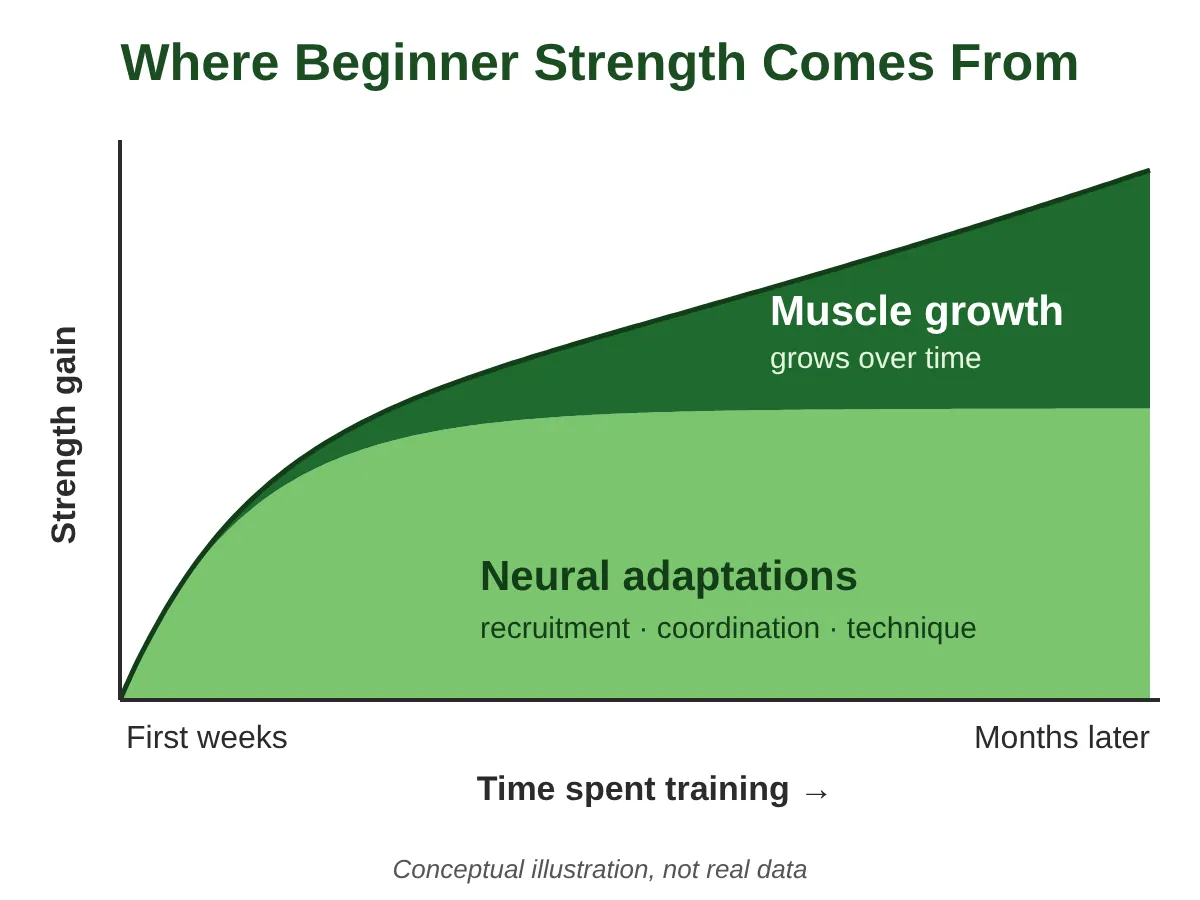
A classic study by Moritani and deVries followed people through eight weeks of training. Neural factors accounted for most of the early strength increase, with muscle growth becoming the dominant contributor after roughly three to five weeks. A more recent review in the European Journal of Applied Physiology agrees that early gains are generally attributed to neural factors, though the exact mechanisms are still being studied.
How Neural Adaptations Make Beginners Stronger
Better Motor-Unit Recruitment
Every muscle is controlled by motor units, each one a nerve cell plus the muscle fibers it activates. When you’re new to lifting, your nervous system isn’t yet very good at driving those units hard. In a 2019 study in The Journal of Physiology, just four weeks of strength training led motor units to fire faster and switch on at lower force levels. Same muscle, more output.
Improved Coordination
Lifting is a skill, so with practice your body gets better at coordinating the muscles that work together during a movement. That’s why a client’s squat often goes from shaky to steady long before their quads change shape.
Learning Proper Exercise Technique
Good technique puts the load where it belongs. When your bar path is consistent and your brace holds, you waste less energy and can safely handle more weight. Some of that early “strength” is simply learning the movement pattern well.
Where Muscle Growth Fits In
None of this means muscle growth is irrelevant, and it starts sooner than you might expect. One study using MRI found measurable increases in quadriceps size after about 20 days of high-intensity training (Seynnes et al., 2007). Still, in those first weeks, size changes are small compared with how quickly strength climbs.
As the months pass, the balance shifts. Neural improvements begin to level off, and muscle growth becomes a bigger driver of continued progress. Our guide on how long it takes to build muscle walks through a realistic timeline.
Practical Tips for Strength Gains in Beginning Clients
- Master a few key movements. Choose a squat, hinge, push and pull, and practice them often. Repetition teaches your nervous system the pattern.
- Train each major muscle group at least twice a week. That’s the baseline in the American College of Sports Medicine’s 2026 position stand for healthy adults.
- Add load gradually. Once your form is consistent, heavier sets drive strength. For maximal strength, the ACSM points to loads around 80% of your one-rep max for two to three sets, but you don’t need to start there.
- Keep every rep crisp. End a set when your technique starts to break down instead of grinding out sloppy reps.
- Be patient with the mirror. Strength usually improves before your physique does. For the muscle-building side, see our beginner’s guide to gaining muscle.
Frequently Asked Questions
How quickly do beginners get stronger?
Many beginners notice strength gains within the first few weeks, largely thanks to neural adaptations. The pace varies from person to person.
Does fast strength gain mean I’m building muscle?
Not necessarily, because early improvements mostly reflect a nervous system that’s getting better at using existing muscle. Measurable growth can begin within a few weeks, and its share of your progress keeps rising over the following months.
Can training one limb make the other stronger?
Yes, to some degree. It’s called cross-education, and Moritani and deVries observed it in their study. It’s another sign that the nervous system plays a major role in early strength.
The Bottom Line
If you’re new to lifting, or coaching someone who is, the answer to what is primarily responsible for strength gains in beginning clients comes down to the nervous system: better motor-unit recruitment, smoother coordination and cleaner technique. Muscle growth starts early and takes over as the main driver with time. Train consistently, focus on quality reps and think in months, not weeks. Next, read our guide to building a sustainable approach to health and fitness.
Health note: This article is general information, not medical advice. Check with a doctor or registered dietitian before making big changes to your diet or training, especially if you have a health condition, are pregnant or take medication. Read our full disclaimer.