Compound lifts are exercises that move more than one joint and work several muscle groups at once. Think squats, deadlifts, bench presses, overhead presses, pull-ups and rows. If you only have a few hours a week to train, they give you the most strength and muscle-building return for your time.
Here’s how they work and how to do them safely.
What Are Compound Lifts and How Do They Work?
A bicep curl bends one joint, the elbow. A squat bends your ankles, hips and knees together, so your quads, glutes, hamstrings and core all share the load. Because more muscle is involved, you can lift heavier weights, and heavier weights mean a bigger training stimulus.
Research backs this up. In an 8-week study in Frontiers in Physiology, a multi-joint program improved strength and aerobic fitness more than a single-joint program with the same total workload. They also mirror real life: lifting a heavy box is basically a deadlift.
The 6 Most Important Compound Exercises
1. Squat
Stand with feet about shoulder-width apart, brace your core, and sit your hips back and down until your thighs are roughly parallel to the floor. Keep your chest up and knees tracking over your toes. Beginner option: goblet squats holding one dumbbell, or Bulgarian split squats once you’re ready for single-leg work.
2. Deadlift
With the bar over your midfoot, hinge at the hips, grip the bar and keep your back flat. Push the floor away and stand tall, keeping the bar close to your legs. Beginner option: a dumbbell or kettlebell Romanian deadlift. If you’ve had back issues, build a base with our lower back strengthening exercises first.
3. Bench Press
Lie with eyes under the bar and feet flat. Lower the bar to your mid-chest with elbows at roughly 45 degrees, then press up. Use a spotter or safety arms when going heavy. Beginner option: push-ups or dumbbell presses.
4. Overhead Press
Start with the bar at your collarbones, squeeze your glutes and press straight up, moving your head back slightly so the bar clears your chin. Avoid leaning back. Beginner option: seated dumbbell press.
5. Pull-Up
Hang with hands slightly wider than your shoulders, pull your shoulder blades down, and pull until your chin clears the bar. Lower with control. Beginner option: lat pulldowns or band-assisted pull-ups.
6. Bent-Over Row
Hinge forward with a flat back, then pull the weight toward your lower ribs, squeezing your shoulder blades together. Beginner option: one-arm dumbbell rows with a hand on a bench.
Compound Lifts Compared
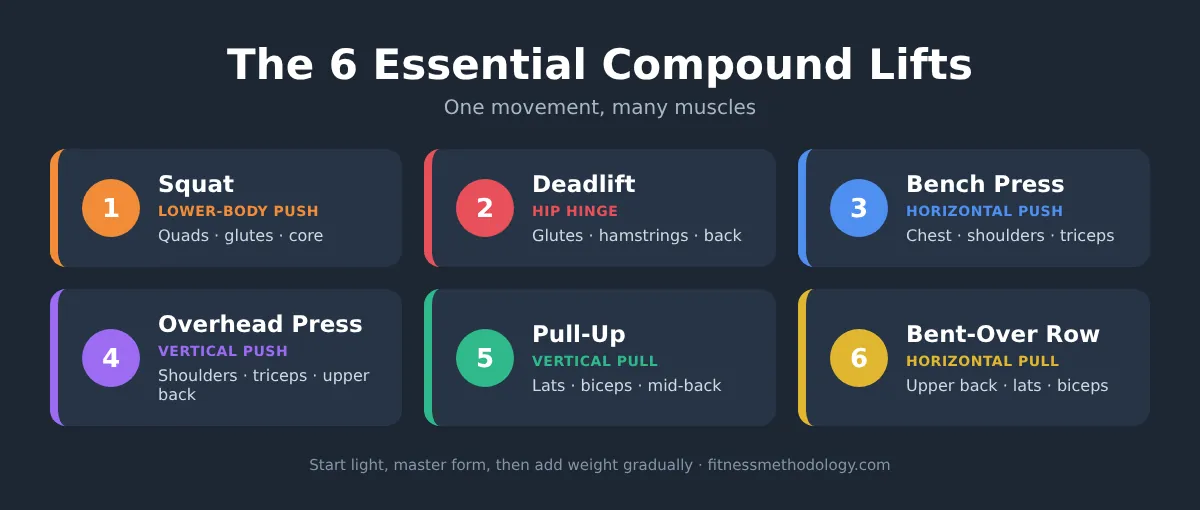
| Lift | Main Muscles | Movement | Easier Version |
|---|---|---|---|
| Squat | Quads, glutes, core | Lower-body push | Goblet squat |
| Deadlift | Glutes, hamstrings, back | Hip hinge | Dumbbell RDL |
| Bench press | Chest, shoulders, triceps | Horizontal push | Push-up |
| Overhead press | Shoulders, triceps, upper back | Vertical push | Seated dumbbell press |
| Pull-up | Lats, biceps, mid-back | Vertical pull | Lat pulldown |
| Row | Upper back, lats, biceps | Horizontal pull | One-arm dumbbell row |
How Beginners Can Add Compound Lifts
The American College of Sports Medicine recommends 2–3 training days a week for novices and doing multi-joint exercises before single-joint ones. A simple example:
- Day A: squat, bench press, row
- Day B: deadlift, overhead press, pull-up or pulldown
Alternate A and B on three non-consecutive days, doing 2–3 sets of 8–12 reps. Start light enough that your form looks the same on the last rep as the first, then add a small amount of weight when every set feels solid. Early progress comes quickly, partly because your nervous system is learning the movement, as we explain in what drives strength gains in beginners.
Common Mistakes to Avoid
- Lifting too heavy too soon. Ego lifting is the fastest route to injury.
- Skipping the warm-up. Do a few light sets before your working weight.
- Rounding your back on deadlifts and rows. Keep it neutral and braced.
- Ignoring pain. Muscle effort is normal; sharp joint pain means stop.
If you have an injury or health condition, check with a doctor or physiotherapist, and consider a session with a qualified coach to learn the lifts.
Frequently Asked Questions
Are compound lifts enough to build muscle?
For most beginners, yes. Isolation exercises can be added later to target smaller muscles. Learn more in our guide on how to gain muscle.
Can I do compound lifts every day?
It isn’t necessary. Muscles need rest to recover, so beginners do best with a day off between sessions.
Do I need a barbell?
No. Dumbbells, kettlebells and bodyweight versions all count.
Final Thoughts
Compound lifts are the backbone of a smart strength routine. Master the six basics with good form, train them two or three times a week and add weight gradually. Results vary, but consistent practice will make you stronger and more capable in everyday life.
Written by Kashan | FitnessMethodology.com — Your trusted destination for practical fitness tips, smarter nutrition, and healthier living. We empower you to make smarter choices, build healthier habits, and achieving your fitness goals .
Health note: This article is general information, not medical advice. Check with a doctor or registered dietitian before making big changes to your diet or training, especially if you have a health condition, are pregnant or take medication. Read our full disclaimer.